The Taung Child, the small fossil skull that first convinced scientists that humanity began in Africa, is about 3 million years old, a new study says. Researchers led by Vrije Universiteit Brussel (VUB) in Belgium now place it between 2.96 and 3.03 million years, older than the 2.8 million years that most popular accounts have quoted for decades.
The age is only half the news. The same team compared how the child’s teeth and brain were growing with adult fossils long filed under the same species, Australopithecus africanus, and found that several of them do not match. Their conclusion is that South Africa 3 million years ago may have held more kinds of early humans than textbooks show, and that our family tree looks less like a trunk and more like a bush.
Key points
- The Taung Child is now dated to 2.96 to 3.03 million years old, according to a 2026 study in npj Palaeoecosystems.
- The lower limit comes from uranium-lead dating of a calcite layer that formed above the fossil-bearing sediment; the upper limit comes from earlier magnetic data.
- The child died at about three years old and had a brain of roughly 400 ml, against about 1,300 ml for a modern adult.
- Several adult fossils grouped as A. africanus grew differently, which suggests they may belong to more than one species.
- Fossil pollen points to a wetter, more wooded South Africa than today, with tree species that now grow far to the northeast.
- The Taung skull remains the only fossil that can be assigned to A. africanus with certainty.
What is the Taung Child?
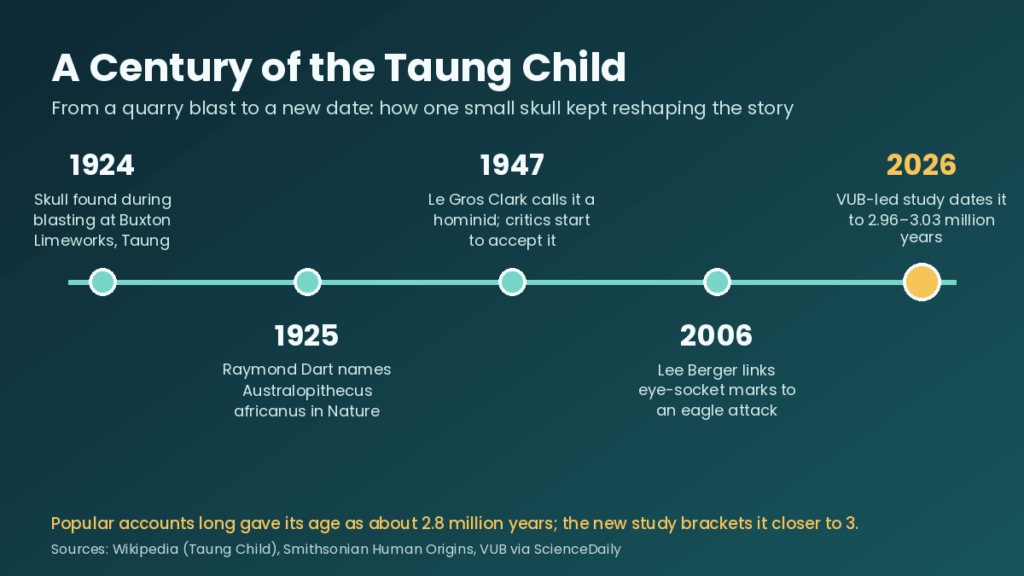
The Taung Child is the fossil skull of a young early human, one of the first early human fossils ever found in Africa. It came to light in 1924, when quarrymen blasting limestone at the Buxton Limeworks near Taung, in what is now North West province of South Africa, turned it up in the rock.
The find travelled an unlikely route to science. Workers passed it to the quarry company’s director, whose son kept it at home, and a family friend, Josephine Salmons, told her mentor Raymond Dart, an anatomist at the University of the Witwatersrand in Johannesburg.
Dart worked fast. About forty days after first seeing the fossil, he published a paper in Nature on 7 February 1925 naming a new species, Australopithecus africanus.
Why scientists first ignored it
Today the Taung skull is a famous object, but in 1925 many leading experts in Britain brushed it aside. They expected the earliest humans to have big brains and ape-like teeth, a picture shaped by the Piltdown Man, a skull later exposed as a hoax.
The Taung Child had a small, ape-sized brain, the opposite of what Piltdown had led them to expect. Acceptance came slowly over two decades, and the turning point is usually dated to 1947, when anatomist Wilfrid Le Gros Clark classed it as a hominid and earlier critics changed their view.
The skull also tells a grim story about how the child died. In 2006 palaeoanthropologist Lee Berger proposed that a large eagle killed it, pointing to puncture marks in the eye sockets that resemble damage seen in primates killed by eagles.
How old is the Taung Child, really?
For a fossil this famous, its age has been oddly uncertain. Estimates over the past century ranged from under one million years to about three million, and reference sources such as the Smithsonian’s Human Origins programme give about 2.8 million years.
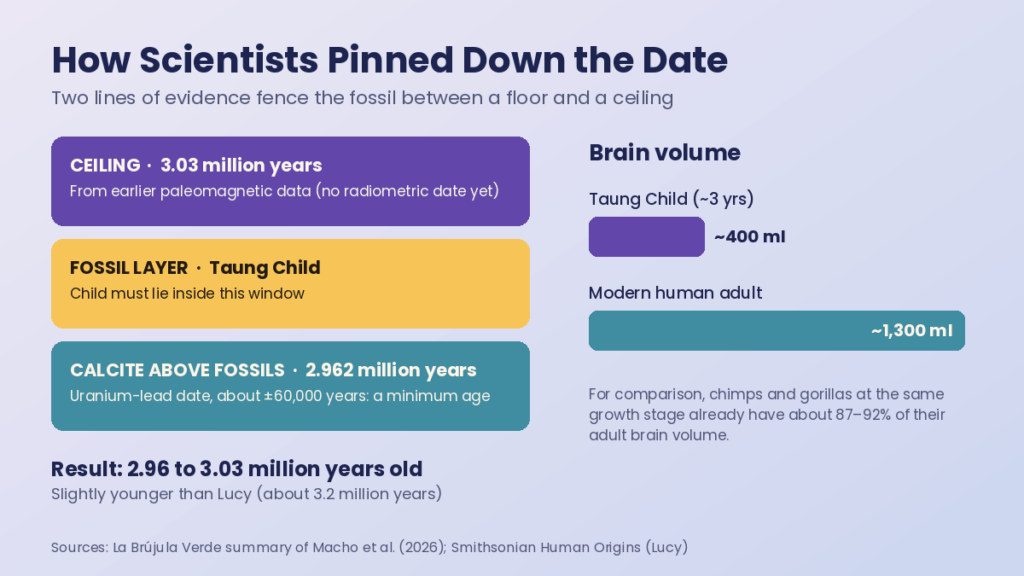
The new study tackled the problem from two sides. First, the team dated a layer of calcite, a mineral crust, that had formed on top of the sediment holding the fossils, using the uranium-lead method, which measures the slow decay of uranium into lead.
That layer came out at about 2.962 million years, with a margin of roughly 60,000 years. Because it sits above the fossils, the child must be at least that old.
For the upper limit, the researchers used earlier palaeomagnetic data, which track changes in Earth’s magnetic field recorded in rock, pointing to about 3.03 million years. The authors note that this ceiling still lacks a radiometric date, so it could be refined later.
| Evidence | What it gives | Value |
|---|---|---|
| Uranium-lead date on calcite above the fossils | Minimum age | about 2.962 million years (± about 60,000) |
| Earlier palaeomagnetic data | Maximum age | about 3.03 million years |
| Combined range | Best estimate | 2.96 to 3.03 million years |
| Older popular figure (Smithsonian) | For comparison | about 2.8 million years |
How a three-year-old’s teeth tell a bigger story
Children’s bodies grow on a timetable, and teeth record that timetable in fine layers. The Taung Child had its first permanent molar in place while the second was still under the gum, which fits an age of about three years at death.
The team looked closely at the boundary between enamel and dentine inside the first molar, a hidden surface whose shape differs between groups. On this measure the Taung Child sits at the edge of the A. africanus range and, on one axis, inside the range of Paranthropus robustus, a heavy-jawed relative from the same region.
They also found that the second molar forms late relative to the first, a pattern also seen in modern humans. That could mean a long childhood or a drawn-out juvenile stage, though the authors say the data cannot yet tell which.
The brain clue: one species or several?
The child’s brain was about 400 ml, roughly the size of a chimpanzee’s. In chimpanzees and gorillas of the same developmental stage, the brain has already reached about 87 to 92 per cent of adult volume, which lets scientists project how large the Taung brain would have grown.
When the team made that projection, the Taung Child could have reached the brain size of most adults placed in A. africanus, but not one well-known skull, StW 505. Its brain shape could match adult fossils such as Sts 5, the skull nicknamed “Mrs. Ples,” but not others such as Sts 71 or MLD 37/38 from Makapansgat.
Those mismatches are the core of the paper. If the only fossil that defines a species grows differently from many fossils given the same name, then that name may be covering more than one kind of early human, living side by side or one after another.
Why A. africanus may be a “poorly defined” species
Here lies an awkward fact of the field. Scientists never laid down firm rules for which later fossils belonged with Dart’s Taung skull, so many adults from caves such as Sterkfontein, about 390 km away, and Makapansgat, farther still, were simply added to A. africanus over the decades.
The study argues that the result is a poorly defined species, and that the Taung Child is still the only fossil that can be assigned to it with certainty. Lead author Gabriele Macho says the findings “turn that on its head,” referring to the long assumption that Taung was just one of many similar fossils.
What the paper does not do is name new species. It leaves open whether the adults that do not fit Taung form one other group, several groups, or mixed populations.
A wetter, greener South Africa
The team also studied fossil pollen from two samples of tufa, a porous limestone, at the site. The pollen suggests that the area around Taung was wetter and more wooded about 3 million years ago than it is today.
Some of the trees in the pollen record now grow hundreds of kilometres to the northeast. The authors call this part of the work a pilot study, so the climate picture is a first look rather than a final answer.
Climate, isolation and a tangled family tree
Southern Africa sits on the boundary between tropical and temperate ecosystems. According to the researchers, repeated swings between wet and dry conditions kept reshaping habitats, splitting early human groups apart and later bringing them back together.
Separated groups would have met different predators and diseases and changed in different ways, and when they met again they sometimes interbred. Macho sums up the result as “a chaotic, tangled bush” rather than a neat line from ape to human.
How the Taung Child compares with Lucy
The most famous early human fossil, Lucy, belongs to a different species, Australopithecus afarensis. She was found in 1974 at Hadar in Ethiopia and is about 3.2 million years old.
With its new date, the Taung Child is only slightly younger than Lucy. The study also notes that a molar from the Makapansgat fossil MLD 2 resembles one from Hadar, a hint that the links between eastern and southern African populations deserve a closer look.
| Fossil | Species | Found | Age |
|---|---|---|---|
| Lucy (AL 288-1) | Australopithecus afarensis | 1974, Hadar, Ethiopia | about 3.2 million years |
| Taung Child | Australopithecus africanus | 1924, Taung, South Africa | 2.96 to 3.03 million years (new study) |
Who did the research?
The study was led by Professor Gabriele Macho of the Archaeology, Environmental Changes and Geo-Chemistry (AMGC) research group at VUB. Co-authors include Simon Neubauer, Clement Zanolli, Pieter Vermeesch, Kevin L. Kuykendall, Andreas Koutsodendris, Laurin S. Kolb and Thibaut Caley.
It appears in npj Palaeoecosystems, a journal in the Nature portfolio, in its first volume. The skull itself is kept at the University of the Witwatersrand.
Why it matters
For a century, the Taung Child has served as the anchor of a species and a symbol of Africa as the cradle of humankind. A firmer date of about 3 million years places it close in time to Lucy and strengthens its value as a reference point.
The bigger lesson is about labels. If fossils long lumped together actually represent several groups, then ideas about which early humans led to our own genus, Homo, may need to be revisited, a point the authors make about the diversity that came before Homo.
For readers, the story is a reminder that science keeps checking its own foundations. A skull found by quarrymen in 1924 is still changing how we understand where we came from.
FAQ
How old is the Taung Child? A 2026 study led by Vrije Universiteit Brussel dates the Taung Child to between 2.96 and 3.03 million years old. Earlier popular sources usually gave about 2.8 million years.
Who discovered the Taung Child? Quarry workers found the skull in 1924 while blasting limestone at the Buxton Limeworks near Taung, South Africa. Anatomist Raymond Dart studied it and named the species Australopithecus africanus in Nature in February 1925.
How old was the Taung Child when it died? It was about three years old, judged from its teeth: the first permanent molar had come in while the second was still under the gum.
How did the Taung Child die? A leading idea, proposed by Lee Berger in 2006, is that a large eagle killed it. Puncture marks in the eye sockets resemble damage seen in primates killed by eagles.
Is the Taung Child older than Lucy? No. Lucy, an Australopithecus afarensis skeleton from Ethiopia, is about 3.2 million years old, so the Taung Child is slightly younger.
Why does the new study say A. africanus may be more than one species? Several adult fossils filed under A. africanus show tooth and brain growth patterns that do not match the Taung Child. Since Taung defines the species, those fossils may belong to other, related groups.
Where is the Taung Child kept today? The skull is held at the University of the Witwatersrand in Johannesburg, South Africa.
Sources and fact-check notes
Sources used (all opened on 21 Nov 2026)
- ScienceDaily: “A 3-million-year-old child just made human evolution far more complicated” (VUB release)
- La Brújula Verde: The Taung Child upends human evolution again
- Archaeology Magazine: Taung Child dated to 3 million years old
- Discover Magazine: The 3-million-year-old Taung Child suggests a tangled bush
- Smithsonian Human Origins: Taung Child
- Smithsonian Human Origins: AL 288-1 “Lucy”
- Wikipedia: Taung Child
- Study: Macho, G. A. et al., npj Palaeoecosystems 1 (2026), DOI 10.1038/s44513-026-00008-2 (journal page did not load today; details taken from the reports above)