The Tata Trusts vs Tata Sons fight has reached the Bombay High Court: the trusts that own about 66% of Tata Sons have sued to cancel N. Chandrasekaran’s reappointment as executive chairman for a third five-year term. They argue that the board’s 17 September vote broke the company’s own rules, because a casting vote was used where the Articles of Association require a “yes” from a majority of the trusts’ nominee directors. Justice Abhay Ahuja is set to hear the case today, Friday 27 November, at 3 pm.
The stakes go well beyond one job. The suit lands three days before a Tata Sons board meeting on 30 November whose top agenda item is a public listing of the group’s holding company, a step the Reserve Bank of India has told Tata Sons to take and the trusts oppose. It is one of the group’s worst boardroom battles, coming a decade after Cyrus Mistry was removed as chairman in 2016.
Key points
- Tata Trusts moved the Bombay High Court on Thursday, 26 November, against Tata Sons and six of its directors.
- Two trusts seek ₹65 crore in damages, ₹50 crore for Sir Dorabji Tata Trust and ₹15 crore for RD Tata Trust, with 18% annual interest, Business Standard reported.
- The board approved Chandrasekaran’s third term 4-1 on 17 September; Noel Tata voted against and an independent director broke the tie between the two trust nominees.
- Chandrasekaran’s current term ends on 20 February 2027.
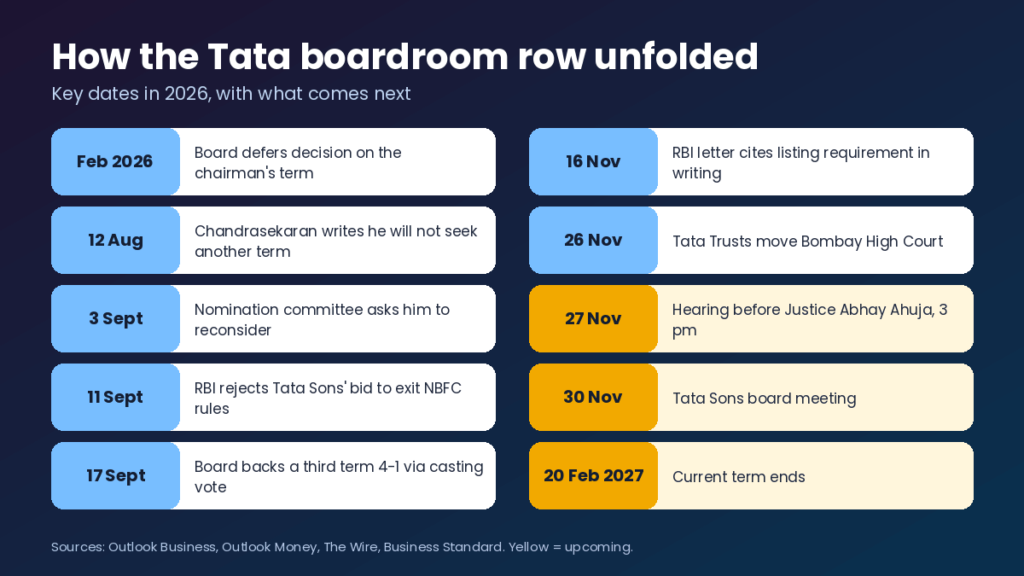
- The RBI wrote to Tata Sons on 16 November asking it to comply with upper-layer NBFC rules, “including the requirement of listing”.
- Abhishek Singhvi is appearing for the trusts and Harish Salve for Tata Sons.
What the Tata Trusts are asking the court for
The trusts want three things, The Wire reported. First, a declaration that the 17 September board resolution reappointing Chandrasekaran is invalid. Second, an order stopping Tata Sons from acting on it. Third, damages.
The defendants are Chandrasekaran, chief financial officer Saurabh Agrawal, independent directors Harish Manwani and Anita George, and the two trust nominees on the board, Venu Srinivasan and Noel Tata himself, according to Business Standard.
The trusts also want the court to stop a repeat at the 30 November meeting. If the two nominee directors split again, they fear the board could push through items such as the listing by the same casting-vote route, the report said.
When the case was first mentioned on Thursday, Justice Arif S. Doctor recused himself, and it was then placed before Justice Abhay Ahuja, The Wire reported.
The casting vote at the centre of the case
The dispute comes down to how one board vote was counted. Tata Sons has six directors, and only two of them, Noel Tata and Venu Srinivasan, are nominees of the trusts that own most of the company, Outlook Business explained.
Article 121 of the Articles of Association says that board decisions need the affirmative vote of a majority of the directors appointed under Article 104B who are present, Business Standard reported. Those directors are the two trust nominees.
On 17 September, the nominees split. Noel Tata voted against the reappointment and Srinivasan voted for it. Harish Manwani, the independent director presiding as head of the nomination and remuneration committee, then used his casting vote in favour.
| Director | Role | Vote on 17 September |
|---|---|---|
| Venu Srinivasan | Trust nominee | For |
| Noel Tata | Trust nominee, Tata Trusts chairman | Against |
| Harish Manwani | Independent director | For (casting vote) |
| Anita George | Independent director | For |
| Saurabh Agrawal | Executive director and CFO | For |
| N. Chandrasekaran | Executive chairman | Did not vote |
The trusts say “a casting vote cannot substitute that affirmative vote”, so the resolution is void. Noel Tata had placed before the board a legal opinion from former Chief Justice D.Y. Chandrachud making the same point, Outlook Business reported. Tata Sons maintains the resolution was validly passed.
How a planned exit became a third term
The reappointment came only weeks after Chandrasekaran had said he was leaving. The board deferred a decision on his term in February 2026 because there was no unanimity, Outlook Business reported.
On 12 August, he wrote to the board that he would not seek another term when his tenure ends on 20 February 2027. The trusts accepted this and started looking for a successor, The Wire said.
Then the board changed course. On 3 September, the nomination and remuneration committee unanimously asked him to reconsider and recommended a fresh five-year term. At the 17 September meeting he agreed, and the board voted.
A split inside the trusts too
The trusts themselves are not united. The decision to sue was taken by a 3-2 vote at Sir Dorabji Tata Trust: Noel Tata, Neville Tata and Bhaskar Bhat in favour, and Venu Srinivasan and Vijay Singh against, The Wire reported. At RD Tata Trust, Noel Tata, Maya Tata and Neville Tata approved it over the same two objectors.
Srinivasan and Singh have written to the Charity Commissioner. They said they do not object to a legal remedy as such, but to “the breadth and foreseeable effect of the relief” sought, Business Standard reported. They also questioned using a public charitable trust’s money in a way that could get in the way of Tata Sons meeting the RBI’s listing rule.
Sir Ratan Tata Trust, the second-largest shareholder, remains frozen, the paper added; there, Srinivasan and Jimmy Tata oppose Noel Tata on both the listing and the third term.
The bigger fight: should Tata Sons list?
Behind the boardroom vote sits a bigger question about the future of the group. The RBI has classified Tata Sons as an upper-layer non-banking financial company since September 2022, and such companies must list within three years, Outlook Money reported. That deadline passed in September 2025.
Tata Sons tried another route. In March 2024 it applied to give up its registration as a core investment company, saying it had repaid its borrowings. The RBI rejected that on 11 September 2026 and told it to follow the upper-layer rules.
On 16 November, in a letter to CFO Saurabh Agrawal, the RBI went further and named listing in writing for the first time. The Tata Sons board is expected to focus on listing at the 30 November meeting, while Noel Tata wants an alternative restructuring that keeps the company private, Business Standard reported.
| Shareholder | Stake in Tata Sons |
|---|---|
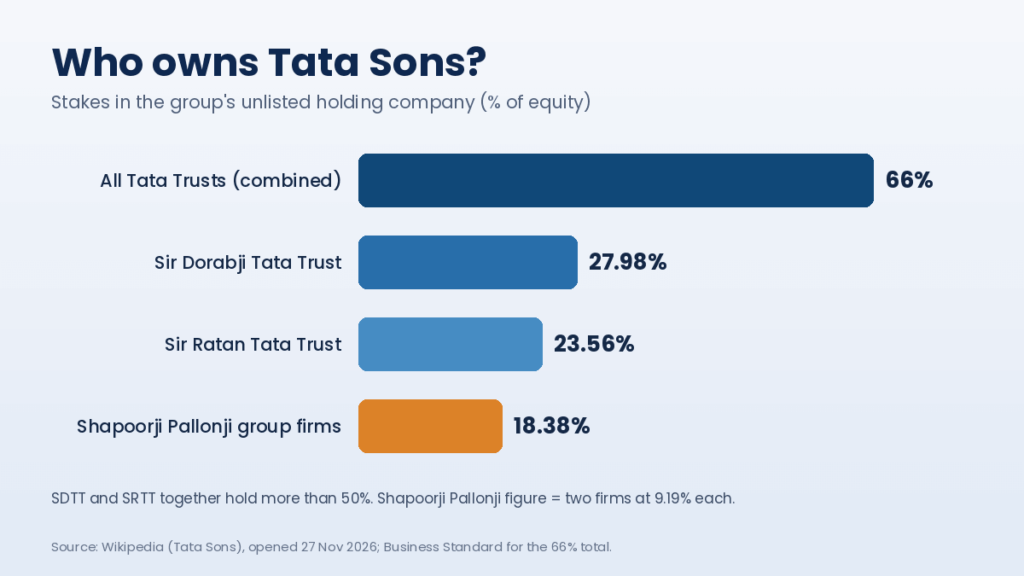
| All Tata Trusts together | About 66% |
| Sir Dorabji Tata Trust | 27.98% |
| Sir Ratan Tata Trust | 23.56% |
| Shapoorji Pallonji group (two firms at 9.19% each) | About 18.4% |
The ownership explains why listing matters so much. A listing could let the Shapoorji Pallonji group, which holds about 18%, monetise part of its stake, Outlook Money noted, while the trusts would see their control diluted over time.
Who are the key players?
- Chandrasekaran. Born in 1963 in Mohanur near Namakkal in Tamil Nadu, he joined TCS in 1987, became its CEO in October 2009, and took over as chairman of Tata Sons on 21 February 2017, Wikipedia records. He is the first non-Parsi professional to lead the group.
Noel Tata. The half-brother of Ratan Tata, he became chairman of Tata Trusts on 11 October 2024, after Ratan Tata’s death, and also chairs Trent and Tata Investment Corporation. He sits on the Tata Sons board as a trust nominee.
Venu Srinivasan. The second trust nominee, he voted for the third term and has opposed the decision to sue, both inside the trusts and in his letter to the Charity Commissioner.
How the market reacted
Investors did not panic. On Thursday morning, Tata group shares moved in a narrow range, Business Standard reported. TCS and Tata Steel rose more than 2%, while Tata Motors fell more than 3% to ₹427.
| Company | Move on 26 November (late morning) |
|---|---|
| TCS | Up over 2%, at ₹2,574 |
| Tata Steel | Up over 2%, at ₹162 |
| Nelco | Up 1.6% |
| Indian Hotels | Down 0.6%, at ₹895 |
| Tata Consumer Products | Down 1.08%, at ₹1,171 |
| Tata Motors | Down over 3%, at ₹427 |
Kranthi Bathini of Wealth Mills Securities said the dispute is unlikely to change the daily running of group companies much, though it could shape the group’s long-term direction.
Why it matters for India
The Tata group, whose brands run from Jaguar Land Rover to Tetley Tea, is one of India’s largest business houses, and Tata Sons is the company that holds its stakes. A fight over who leads it, and whether it lists, matters to everyone who owns shares in its listed companies.
It is also a test of corporate governance. The court will have to decide how a company’s own Articles of Association work when a large owner’s nominees disagree, a question with lessons for other promoter-run groups.
Finally, it is a test for the regulator. The RBI’s rules require upper-layer NBFCs to list within three years of being identified, and Tata Sons is already past that deadline. How the group responds will show how the rule applies to one of India’s biggest holding companies. Tata Sons was founded on 8 December 1917 and reported FY25 revenue of ₹38,835 crore, according to Wikipedia.
What happens next
The first answer comes today. Justice Abhay Ahuja hears the suit at 3 pm and may decide whether to grant interim relief, such as staying the casting vote or limiting what the board can take up on 30 November.
On Monday, 30 November, the Tata Sons board meets with listing at the top of its agenda; Noel Tata has reportedly asked for his own issues to be discussed first. The Charity Commissioner has yet to respond to Srinivasan and Singh’s letter.
The deadline that frames it all is 20 February 2027, when Chandrasekaran’s current term ends. What the court decides about the 17 September vote will shape who leads the group after that date.
FAQ
Why did Tata Trusts go to court against Tata Sons? Tata Trusts say the 17 September board resolution giving N. Chandrasekaran a third term is void, because it passed on a casting vote without the affirmative vote of a majority of the trusts’ two nominee directors that the Articles of Association require. They want it declared invalid and seek ₹65 crore in damages.
When is the Bombay High Court hearing in the Tata Trusts case? Justice Abhay Ahuja is scheduled to hear it on Friday, 27 November 2026, at 3 pm, after Justice Arif S. Doctor recused himself.
What is Article 121 of the Tata Sons Articles of Association? It says matters decided by the board need the affirmative vote of a majority of the directors appointed under Article 104B, the trust nominees, who are present.
How much of Tata Sons does Tata Trusts own? About 66%. The two largest trusts, Sir Dorabji Tata Trust (27.98%) and Sir Ratan Tata Trust (23.56%), together hold more than half.
When does Chandrasekaran’s term as Tata Sons chairman end? His current term ends on 20 February 2027. The board voted on 17 September 2026 to give him a third five-year term, which the trusts are challenging.
Why does the RBI want Tata Sons to list? The RBI classed Tata Sons as an upper-layer NBFC in September 2022, and such companies must list within three years. On 16 November 2026 it told Tata Sons in writing to comply, including the listing requirement.
Did Tata group shares fall after the court move? Not broadly. On 26 November most group stocks moved in a narrow range; TCS and Tata Steel rose over 2%, while Tata Motors fell over 3%.
Sources and fact-check notes
All pages below were opened on 27 November 2026.
- Business Standard: Tata Trusts to move court against Chandrasekaran’s third term (26 November 2026): Article 121/104B, damages, defendants, lawyers, SDTT vote, SRTT frozen, Charity Commissioner letter, 27 November hearing, 30 November meeting
- The Wire: Tata Trusts move Bombay HC (26 November 2026): reliefs, third five-year term, 4-1 vote, trust votes, recusal and listing before Justice Abhay Ahuja
- Outlook Business: Voting math behind boardroom battle: six-member board, nominee directors, casting vote, Chandrachud opinion, February/August/September dates
- Business Standard: Tata stocks trade mixed (26 November 2026): share moves, board meeting moved to 30 November, analyst comment
- Outlook Money: RBI puts Tata Sons’ listing requirement in writing: 16 November letter, September 2022 classification, three-year rule, CIC surrender rejected 11 September 2026, Shapoorji Pallonji stake
- Deccan Chronicle (PTI/Reuters): Tata Trusts to move Bombay HC (26 November 2026): “worst boardroom battles”, brands
- Wikipedia: Tata Sons: founding date, shareholding split, Chandrasekaran’s start, FY25 revenue
- Wikipedia: Natarajan Chandrasekaran: birth, TCS career, first non-Parsi chairman
- Wikipedia: Noel Tata: Tata Trusts chairman from 11 October 2024, other roles