The narwhal tusk is not one spiral but two, twisting in opposite directions like the strands of a rope, according to a study published in Nature Communications. That hidden design explains how a tooth that can grow to about 2 metres stays straight and strong, and it may one day inspire tougher human-made materials.
For centuries, Europeans sold these long ivory spears as “unicorn horns” with magical powers. Now a team from Denmark, Sweden, Switzerland, France and Greenland has used powerful X-ray machines to map the tusk from the atomic scale up, and the real secret turns out to be engineering, not magic.
Key points
- The narwhal tusk has a double spiral: the outer cementum layer twists left, while the inner dentin twists right.
- The opposing spirals make the tusk resist bending and twisting better than a single spiral or a straight rod, according to the researchers’ tests.
- The work used 3D “tensor tomography” at three European synchrotrons: MAX IV in Sweden, the Swiss Light Source and the ESRF in France.
- The tusk is the narwhal’s left canine tooth. It has no enamel and can exceed 2 metres.
- Growth layers in the tusk work like tree rings and could record decades of Arctic climate history.
- In 1660, Denmark’s King Frederik III had a throne built from narwhal tusk, passed off as unicorn horn.
What is a narwhal, and why does it have a tusk?
The narwhal (Monodon monoceros) is a toothed whale of the Arctic, often called the “unicorn of the sea“. It lives mainly in the Atlantic side of the Arctic Ocean, from northern Canada to Greenland and Russia, and moves with the seasonal sea ice.
The famous tusk is actually a tooth. In males, the left upper tooth usually starts growing outward around the age of two or three and keeps growing through life, says the US agency NOAA Fisheries.
Why it exists is still debated. NOAA describes it mainly as a sexual signal used in mate choice and status, and notes it may also sense changes in the environment. Harvard dentist and narwhal expert Martin Nweeia has called it “the most extraordinary tooth on the planet”.
| Fact | Figure | Source |
|---|---|---|
| Body length | About 4 to 5.5 metres (13 to 18 feet) | NOAA Fisheries |
| Weight | About 800 to 1,600 kg; WWF gives up to 1,900 kg | NOAA, WWF |
| Tusk length | Up to about 3 metres (9.8 to 10 feet) | NOAA, WWF |
| Tusk weight | Over 9 kg (20 pounds) | NOAA Fisheries |
| Population | More than 80,000 | WWF |
| Conservation status | Least Concern (IUCN) | WWF |
| Deepest dives | About 1,200 metres, up to 25 minutes | NOAA Fisheries |
What the scientists found inside the tusk
The study, titled “The narwhal tusk assembles its macroscopic helix from building blocks with opposing twists”, was led by first author Adrian Rodriguez-Palomo. The project was run from Aarhus University in Denmark under chemist Henrik Birkedal, with Marianne Liebi of the Paul Scherrer Institute and Chalmers University among the co-authors.
The tusk has two main layers. The outer layer, called cementum, forms a left-handed helix. The inner dentin, made of mineralised collagen fibres, spirals the other way, to the right.
The fibres mostly run along the length of the tooth, but they lean at small angles, and that lean creates the twist. Where the two layers meet, the boundary turned out to be far more intricate than scientists had assumed.
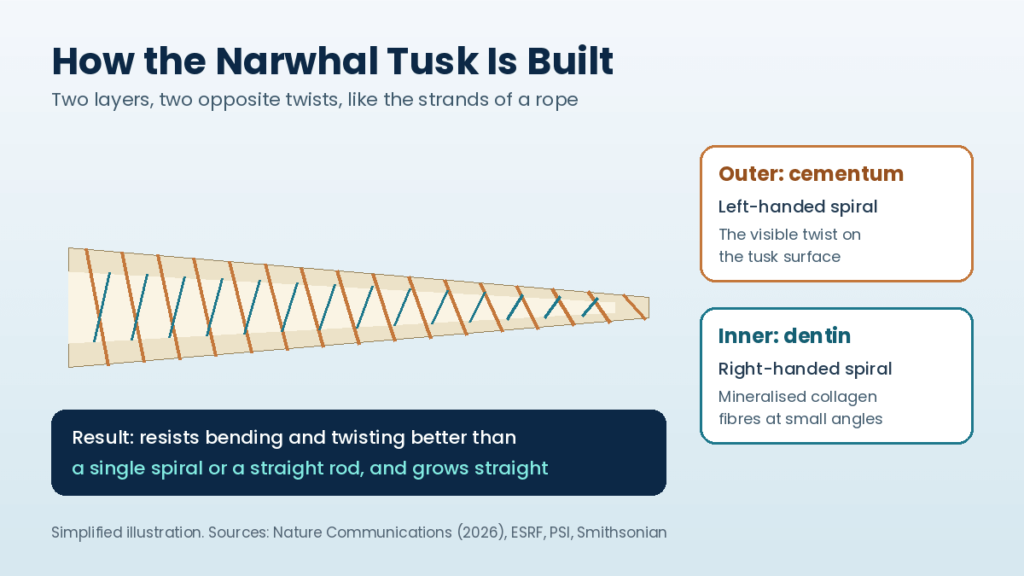
The biggest surprise came at a tiny scale. Liebi said the building blocks “already formed a spiral” in a millimetre-sized sample, even though the whole tusk is metres long. In other words, the twist is built into the material itself, not just the shape.
How a double spiral makes the tusk strong and straight
Think of a rope, whose twisted strands hold together better under load than loose fibres would. The researchers compare the narwhal tusk to exactly that.
According to the researchers, the opposing helices resist torsion and other mechanical stress. Mechanical tests reported by Smithsonian magazine compared the tusk’s structure with single-spiral and non-spiral rods, and the double spiral held up better against bending and twisting.
The design may also explain one of the narwhal’s oddities. It is the only known animal with a long, straight tusk that visibly spirals to the left, and the counter-twisting layers appear to help it grow straight.
Liebi summed up the problem nature had to solve: the tusk “must be both hard and flexible”. A long tooth that sticks out of the head has to survive knocks, ice and rivals without snapping.
How the X-ray study was done
The team mapped the tooth in three dimensions at atomic, nano and micro scales. They used several X-ray methods, chiefly tensor tomography, which rotates a sample in the beam and combines millions of measurements into a 3D map of how its fibres are arranged.
That needed three large particle-accelerator light sources: MAX IV in Lund, Sweden; the Swiss Light Source at PSI in Villigen, Switzerland; and the European Synchrotron Radiation Facility (ESRF) in Grenoble, France. Rodriguez-Palomo said no one had carried out “such an advanced experiment of this type” before.
Some tusks came from Greenlandic Inuit subsistence hunters, and others from the Greenland Institute of Natural Resources. One full skull with its tusk was also scanned in a CT machine. The project was funded by NordForsk under the name “Narwhal tusks – a tale with a twist”, with support from the EU’s Marie Skłodowska-Curie programme.
From ‘unicorn horn’ to science: the tusk’s strange history
Long before X-rays, the narwhal tusk had a second life in European myth. Medieval Europeans believed in unicorns, and traders sold narwhal tusks to rich buyers as unicorn horns, according to the Metropolitan Museum of Art.
People shaved bits of these “horns” into drinks as medicine and believed they protected against poison, a real fear in royal courts. The Met notes that Queen Elizabeth I reportedly drank from a goblet said to be carved from unicorn horn. Rulers in Scotland and Denmark prized the tusks most.
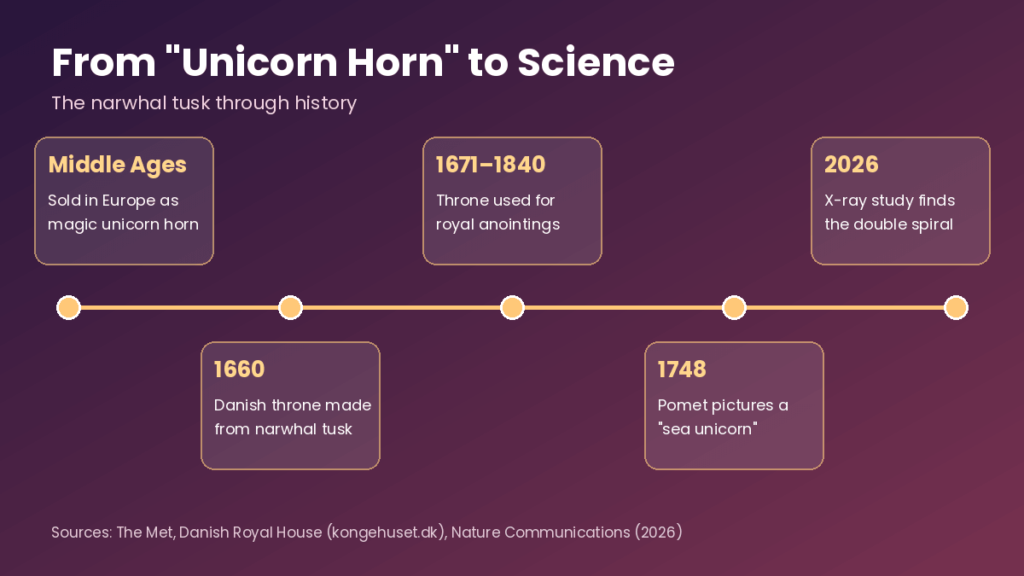
The most famous example still stands in Copenhagen. In 1660, Bendix Grodtschilling made an anointing throne for King Frederik III from narwhal tusk, presented as unicorn horn, says the Danish Royal House. It was used from 1671 until 1840 and now sits in the Great Hall of Rosenborg Castle.
| Year | Event | Source |
|---|---|---|
| Middle Ages to 1700s | Narwhal tusks sold across Europe as magical unicorn horns | The Met |
| 1660 | Throne of narwhal tusk made for Denmark’s Frederik III | Danish Royal House |
| 1671 | Throne first used, at Christian V’s anointing | Danish Royal House |
| 1748 | Pierre Pomet’s book pictures a narwhal as “Licorne de mer” (sea unicorn) | The Met |
| 1840 | Throne last used, at Christian VIII’s anointing | Danish Royal House |
| 2026 | X-ray study reveals the tusk’s double spiral | Nature Communications |
A tusk that keeps a diary of the Arctic
The narwhal tusk grows in yearly layers, much like tree rings, and the double spiral repeats in each one. Birkedal said the teeth form “a kind of historical record” of the conditions an animal lived through.
That matters because narwhals live long. The Chalmers and ESRF teams put the lifespan at up to about 80 years, and the PSI release says a male can approach a century. NOAA gives a more cautious “at least 25 years and up to 50”. Either way, one tusk can hold decades of data.
The researchers say their next step is to read those layers to rebuild past Arctic climate and food conditions. With sea ice shrinking, WWF lists climate change, shipping noise and oil and gas activity as key threats to narwhals, so a natural archive of change is valuable.
Why it matters for India
India has its own stake in the Arctic. Its research station Himadri at Ny-Ålesund in Norway’s Svalbard islands, about 1,200 km from the North Pole, was inaugurated on 1 July 2008, according to the National Centre for Polar and Ocean Research. Arctic ice loss shapes global climate, and Indian scientists study it from there.
The materials lesson travels too. The researchers say the tusk’s structure could, in the long term, inspire new strong materials. Many engineered materials face the same challenge as the narwhal’s tooth: being hard and flexible at once.
Finally, the story shows how big science now works. The study needed chemists, physicists, marine biologists and materials scientists, plus three large X-ray facilities, to answer a question about one tooth.
What happens next
The narwhal tusk is a reminder that nature often solves engineering problems before people do. A double spiral, set in place from the millimetre scale upward, lets a single tooth grow straight to 2 metres and survive the Arctic.
The same tusk that fooled kings as a unicorn horn may now help scientists read Arctic history and design better materials. The next chapter is the growth-ring work, which could turn museum and hunter-collected tusks into a long record of a warming polar ocean.
FAQ
Is a narwhal tusk a horn or a tooth? It is a tooth. It is the narwhal’s left canine, which grows out through the upper lip, mostly in males, and has no enamel.
Why does the narwhal tusk spiral? The 2026 study found two spirals: the outer cementum twists left and the inner dentin twists right. Together they resist bending and twisting, and appear to help the tusk grow straight.
How long can a narwhal tusk grow? The researchers say it can exceed 2 metres. NOAA and WWF give a maximum of about 3 metres (9.8 to 10 feet).
Were unicorn horns really narwhal tusks? Many were. The Metropolitan Museum of Art says the “unicorn horns” sold to European royalty until the 1700s were often narwhal tusks.
What is the Danish throne made of narwhal tusk? It is the anointing throne made in 1660 for King Frederik III by Bendix Grodtschilling. It was used until 1840 and is now in Rosenborg Castle, Copenhagen.
Are narwhals endangered? No. WWF lists them as Least Concern, with more than 80,000 animals, but climate change and shipping are growing threats.
How long do narwhals live? Estimates vary. NOAA says 25 to 50 years, while the study teams say up to about 80 years, and possibly close to a century for males.
Sources and fact-check notes
Pages opened (28 Nov 2026)
- Paul Scherrer Institute release via ScienceDaily (27 Nov 2026): journal reference, DOI 10.1038/s41467-026-75689-z, tensor tomography, 2 m tusk, lifespan, Liebi quotes
- Chalmers University of Technology news (18 Aug 2026): authors, three synchrotrons, millimetre-scale spiral, Frederik III throne, 80-year lifespan, NordForsk funding
- ESRF news (18 Aug 2026): left canine, no enamel, fibril angles, Rodriguez-Palomo and Birkedal quotes
- Smithsonian magazine: mechanical tests, CT scan, Inuit-hunter samples, Nweeia quote
- NOAA Fisheries: Narwhal: size, weight, lifespan, tusk length and weight, diving depth
- WWF: Narwhal: population, IUCN status, threats
- The Met: The Unicorn and the Narwhal: unicorn-horn trade, Elizabeth I goblet, Pomet 1748
- Danish Royal House: The anointing throne: 1660, Grodtschilling, 1671–1840, Rosenborg
- NCPOR: Himadri station: 1 July 2008, Ny-Ålesund, 1,200 km from the North Pole