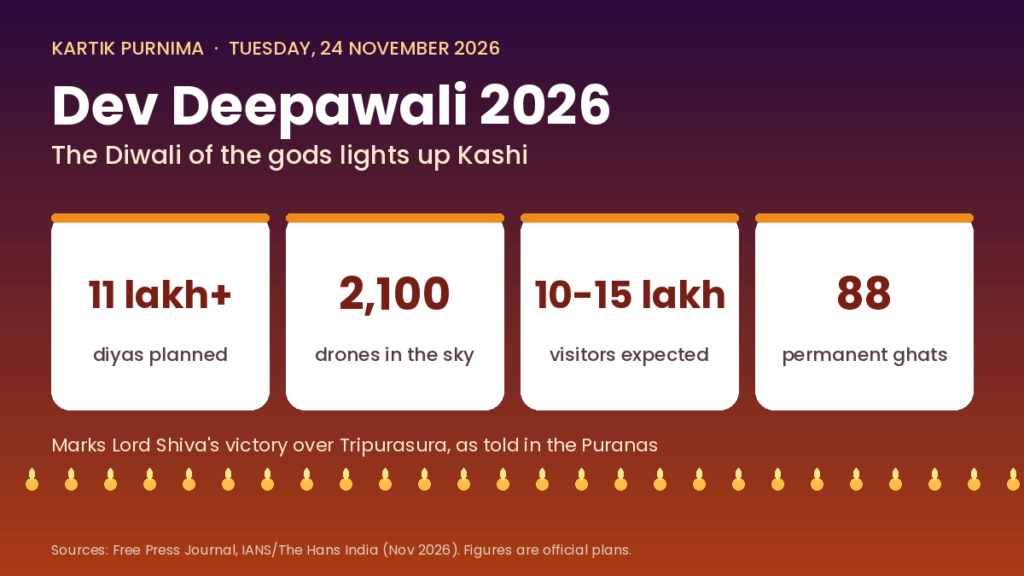
Dev Deepawali 2026 falls today, Tuesday, 24 November, on Kartik Purnima, and Varanasi is set to light more than 11 lakh diyas on its ghats, river sands and kunds. The festival, often called the “Diwali of the gods”, arrives fifteen days after Diwali and marks the traditional account of Lord Shiva destroying the three flying cities of Tripurasura.
Behind the drones, laser shows and sold-out boats is one of the oldest stories in Indian tradition. It is a tale of a boon with a loophole, three cities that aligned once in a thousand years, and a single arrow fired from a chariot made of the universe itself. Here is the legend, the other stories tied to this full moon, and what Kashi has planned for tonight.
Key points
- Dev Deepawali 2026 is on Tuesday, 24 November; the Purnima tithi ends at about 8:23 pm IST on 24 November.
- Tradition says the gods descended to Kashi and lit lamps after Shiva, as Tripurantaka, destroyed Tripura.
- Varanasi plans over 11 lakh lamps, including about 1 lakh cow-dung diyas, and a 2,100-drone show.
- Officials expect 10 to 15 lakh devotees and tourists.
- The same full moon is Guru Nanak Jayanti, the 557th birth anniversary of the first Sikh Guru.
- The Dashashwamedh Maha Aarti this year is dedicated to Kargil War martyrs.
Why is it called the Diwali of the gods?
Diwali celebrates Lord Rama’s return to Ayodhya, a human king coming home. Dev Deepawali is different: in the traditional account, it is the devas themselves who light the lamps.
The belief is that on the full moon of Kartik, the gods come down to the banks of the Ganga in Kashi to bathe and celebrate Shiva’s victory. Devotees light diyas to welcome them. That is why the day is also called Tripurari Purnima, after Tripurari, “the enemy of Tripura”, a name of Shiva.
Another reading adds Vishnu to the story. Some traditions hold that Vishnu returns to his own abode on this day after staying with King Mahabali, which gives the gods a second reason to celebrate.
The legend of Tripurasura: three cities and one arrow
The story begins after a war. In the traditional account, Kartikeya, Shiva’s son, killed the demon Tarakasura. Taraka’s three sons, Tarakaksha, Kamalaksha and Vidyunmali, wanted revenge and power.
They performed long and severe penance until Brahma appeared before them. They asked for immortality. Brahma refused, because nothing in creation can last forever.
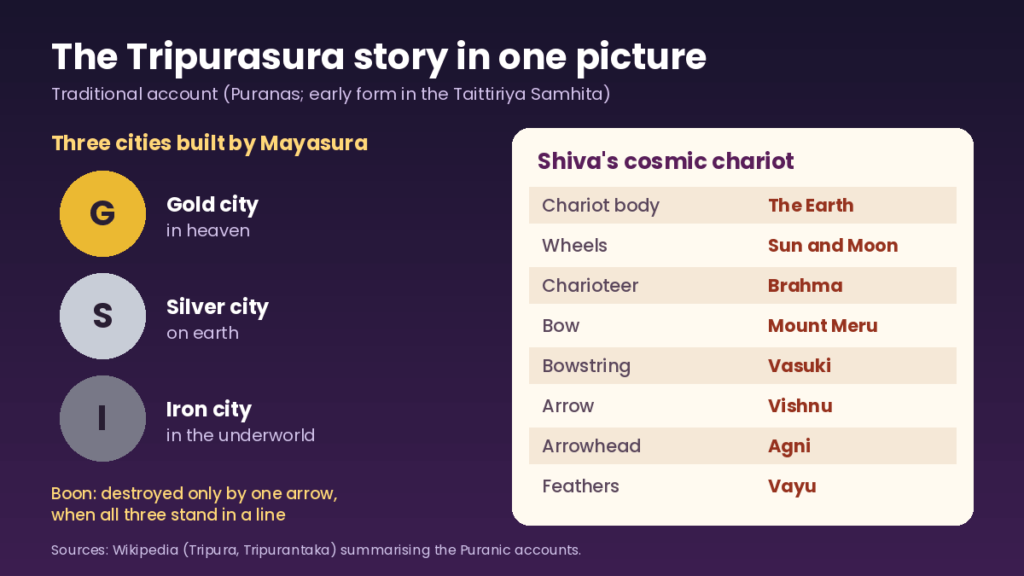
So the brothers asked for something cleverer. They wanted three fortress-cities that could only be destroyed by a single arrow, and only when all three stood in one line. Brahma granted the boon.
Mayasura builds Tripura
The asura architect Mayasura built the three cities. As the legend goes, one was of gold in heaven, one of silver on the earth, and one of iron in the underworld.
The cities moved through the sky on their own paths. They came into one line only for a brief moment, roughly once in a thousand years, when the moon met the Pushya nakshatra. Safe behind this rule, the three brothers grew arrogant and began to trouble the gods and sages.
The devas, led by Indra, went to Brahma for help. Brahma told them that only Shiva could fire the arrow that the boon demanded.
A chariot made of the cosmos
The battle that followed is described on a cosmic scale. The traditional account lists every part of Shiva’s chariot and weapon:
| Part | What it was made of |
|---|---|
| Body of the chariot | The Earth |
| Wheels | The Sun and the Moon |
| Charioteer | Brahma |
| Bow | Mount Meru |
| Bowstring | Vasuki, the serpent king |
| Arrow | Vishnu |
| Arrowhead | Agni, the fire god |
| Feathers of the arrow | Vayu, the wind god |
In one version, Vishnu also took the form of a bull to set the heavy chariot moving. When the three cities finally came into line, Shiva was ready.
The smile that burned three cities
A striking detail sits at the heart of the story. Seeing the devas proud of their part in the chariot, Shiva only smiled, and the three cities caught fire.
Brahma then urged him to release the arrow anyway, so the gods would not feel their effort was wasted. Shiva fired, and Tripura was reduced to ashes. Mayasura, warned by Nandi, escaped before the arrow struck.
Shiva then danced the Tandava over the ruins. The victory gave him the name Tripurantaka, “the one who ended Tripura”. The gods lit lamps in joy, and that celebration is what Dev Deepawali remembers.
Where the story is written
The Tripura legend is very old. A short version already appears in the Taittiriya Samhita of the Krishna (Black) Yajurveda, which speaks of three asura citadels of iron, silver and gold and an arrow with Agni as its point and Vishnu as its shaft.
Later texts tell it in full. The Padma Purana gives the detailed account of Taraka’s sons and Brahma’s boon, and the Shiva Purana links Shiva’s victory to Kartik Purnima, according to reports quoting Varanasi astrologer Pandit Rishi Dwivedi.
Temple art kept the story alive in stone. Tripurantaka, usually shown as a four-armed archer with the Pinaka bow, appears in early Chalukya work at Pattadakal, at the Kailasanatha temple in Ellora, and in Hoysala temples in Karnataka.
Other stories of this full moon
Kartik Purnima carries more than one legend. Different communities remember different events on the same night:
- Matsya avatar: The day is linked to the appearance of Vishnu’s fish incarnation, the first of his ten avatars.
- Kartikeya: In parts of South India, it is marked as the birthday of Kartikeya, Shiva’s younger son.
- Tulsi and Vishnu: The Brahma Vaivarta Purana tells how Tulsi’s essence became the sacred tulsi plant and the Gandaki river.
- Radha and Krishna: Vaishnava traditions hold that the raas leela was performed on this night, and raas performances are held at temples such as Jagannath in Puri.
- Jain pilgrimage: Jains visit the Shatrunjaya hills at Palitana, linked to Adinath, the first tirthankara.
Guru Nanak Jayanti on the same day
For Sikhs, this full moon is Gurpurab, the Prakash Purab of Guru Nanak Dev Ji. This year marks his 557th birth anniversary.
Guru Nanak was born in 1469 at Rai Bhoi Ki Talwandi, now Nankana Sahib in Pakistan, to Mehta Kalu and Mata Tripta.
Some Sikh scholars note that his birth may have been in Baisakh (April), and that the celebration moved to Katik in the time of Maharaja Ranjit Singh. The festival itself is still celebrated on Kartik Purnima.
How Varanasi will celebrate tonight
Kashi’s celebration has grown into one of India’s biggest festival events. This year’s plan, as reported by the state government, centres on over 11 lakh lamps spread across the city’s waterfront.
| Location | Diyas planned |
|---|---|
| 88 permanent ghats (83 committees) | 5 lakh |
| Sandy stretch across the Ganga | 3.5 lakh |
| 103 kunds and ponds | 2.5 lakh |
| Dashashwamedh Ghat Maha Aarti | 51,000 |
| Pushkar Talab tribute | 2,100 |
About 10 lakh of the lamps are earthen diyas and about 1 lakh are made of cow dung, presented as an eco-friendly choice. The ghats have been split into 20 sectors and the sandy stretch into 14 for crowd control.
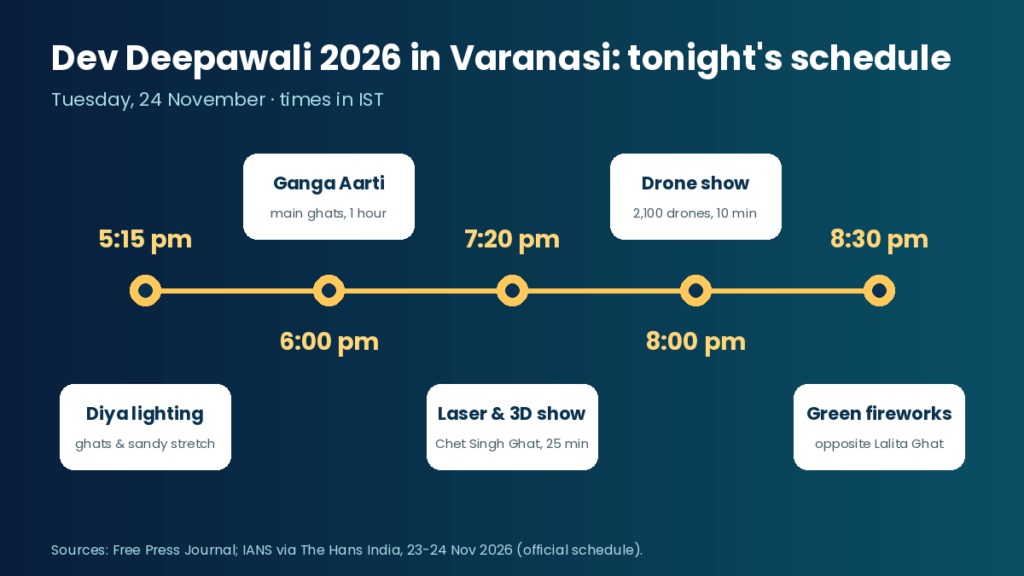
The evening runs on a tight schedule. Lamps are lit from 5:15 pm to 5:45 pm, the Ganga Aarti follows from 6 pm, and a 25-minute 3D projection and laser show begins at Chet Singh Ghat at 7:20 pm.
At 8 pm, 2,100 indigenous drones will fly a 10-minute show on themes such as Lord Shiva, the Shiv Tandav and the descent of the Ganga. Green fireworks opposite Lalita Ghat close the night at 8:30 pm.
A tribute to soldiers and to Kashi’s greats
Dev Deepawali in Varanasi also honours those who died for the country. At Dashashwamedh Ghat, 21 priests and 42 Dev Kanyas will perform the Maha Aarti, dedicated this year to the martyrs of the Kargil War, with a wreath laid at a replica of the Amar Jawan Jyoti.
At Pushkar Talab, 2,100 diyas will honour Kashi’s famous sons and daughters, including Madan Mohan Malaviya, Bismillah Khan and Girija Devi. The Gangotri Seva Samiti will offer 151 litres of milk to the Ganga and display a 108-kg ashtadhatu idol of the river goddess.
Uttar Pradesh Tourism and Culture Minister Jaiveer Singh is the chief guest. Chief Minister Yogi Adityanath sent “heartfelt congratulations and best wishes” to devotees in a post on X.
From a few lamps to a global event
The modern festival is far younger than the legend, and accounts of its start differ. One widely reported version says five teenagers led by Vagish Dutt Mishra revived the custom at Panchganga Ghat in 1984 with two cans of donated oil; other accounts date it to 1985.
Another account credits Pandit Kishori Raman Dubey, known as Babu Maharaj, with starting the lamp-lighting at Dashashwamedh Ghat in 1991. What is clear is how fast it grew: nearly 21 lakh diyas were reported across the city in 2022, and about 25 lakh in 2025, counting the ghats and the Kashi Vishwanath temple premises.
How families mark Kartik Purnima at home
Away from the ghats, the day is simple and personal. Many people take a holy dip in the Ganga or a nearby river at dawn and offer lamps to the river, the gods and their ancestors. This offering is called deepdaan.
Through the month of Kartik, many households also raise an akash deep, a lamp hung high on a pole, in memory of departed family members. The suggested deepdaan time in Varanasi this evening is about 5:08 pm to 7:47 pm.
Why it matters
The Tripurasura story is more than a battle scene. It is about pride and its limits: a boon with a clever loophole, gods proud of their own role, and a smile that did what an army could not.
For Varanasi, the festival has become a meeting point of faith, memory and tourism, drawing lakhs of people to the river in a single evening. For millions of others, the same full moon brings Guru Nanak’s birth anniversary, rows of lamps in Telugu homes and boat-floating (Boita Bandana) in Odisha, a reminder of how one night can hold many traditions at once.
FAQ
When is Dev Deepawali 2026?
Dev Deepawali 2026 is on Tuesday, 24 November, the full moon (Purnima) of Kartik. The Purnima tithi ends at about 8:23 pm IST that day.
Why is Dev Deepawali called the Diwali of the gods?
In the traditional account, the gods descended to Kashi and lit lamps on the Ganga ghats to celebrate Lord Shiva’s destruction of Tripurasura. People light diyas to welcome the devas, so the festival is called Dev Deepawali.
Who was Tripurasura?
Tripurasura is the name given to the three asura sons of Tarakasura, Tarakaksha, Kamalaksha and Vidyunmali, and their three cities. Brahma’s boon said the cities could fall only to a single arrow when all three were in line.
Which text tells the Tripurasura story?
An early form appears in the Taittiriya Samhita of the Krishna Yajurveda. The full story is told in the Puranas, including the Padma Purana and the Shiva Purana.
How many diyas will be lit in Varanasi on Dev Deepawali 2026?
The Uttar Pradesh government plans over 11 lakh lamps, about 1 lakh of them made from cow dung. They will be spread across 88 ghats, the sandy stretch across the Ganga and 103 kunds.
What time is the Dev Deepawali drone show in Varanasi?
A 10-minute show with 2,100 indigenous drones is scheduled from 8 pm to 8:10 pm on the sandy stretch across the Ganga. A laser and 3D projection show at Chet Singh Ghat starts earlier, at 7:20 pm.
Is Guru Nanak Jayanti on the same day as Dev Deepawali in 2026?
Yes. Guru Nanak Jayanti, his 557th birth anniversary, also falls on Kartik Purnima, 24 November 2026.
Sources and fact-check notes
Pages opened (24 Nov 2026)
- Free Press Journal: Varanasi Dev Deepawali 2026, 11 lakh diyas, 2,100 drones, 15 lakh visitors (updated 23 Nov 2026)
- The Hans India / IANS: CM Yogi extends Dev Deepawali greetings (24 Nov 2026)
- Organiser: How Dev Deepawali grew from two cans of oil (15 Nov 2026)
- Hindutone: Kartika Purnima 2026 date
- Wikipedia: Kartik Purnima
- Wikipedia: Tripura (mythology)
- Wikipedia: Tripurantaka
- Wikipedia: Dev Deepavali (Varanasi)
- Brut India: Guru Nanak Jayanti 2026 (18 Nov 2026)