Based on reports available as of October 8, 2026. Many figures below are official claims from one side or the other and cannot be independently verified.
As the full-scale invasion enters its fifth year, the Russia-Ukraine war is widely described as the world’s first true drone war. The fighting is no longer defined only by tanks and artillery. It is shaped by a fast cycle of cheap unmanned systems and the countermeasures built to stop them, and both armies are adapting in months, not years.

Mass production is the new baseline
Ukraine’s Defense Ministry codified 413 unmanned aerial systems in the first half of 2026, up 73% on 2024. Of 1,000 weapons samples authorized in that period, 892 were made in Ukraine, a domestic share of nearly 90%, up from about 70% in 2025. Kyiv has said it aims to build seven million drones in 2026, roughly double its 2025 output.
The scale of production matters as much as the technology. A drone that costs a few hundred dollars can threaten equipment worth thousands or millions, and this cost imbalance is what has pushed both sides toward quantity.
Fiber-optic drones: the answer to jamming
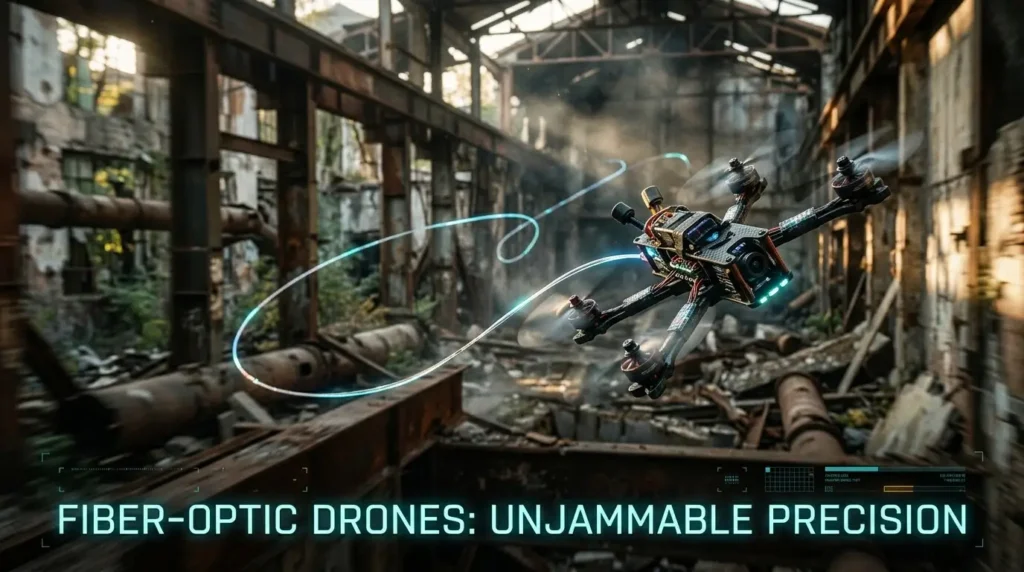
For most of the war, electronic warfare was the main defense against first-person-view (FPV) drones. Jammers cut the radio link between pilot and drone. Fiber-optic drones changed that. They trail a hair-thin cable and take their commands down the wire, so there is no radio signal to jam.
- Russia moved first at scale. Fiber-optic drones emerged in large numbers in August 2024 during fighting in Russia’s Kursk region, and the Atlantic Council notes they helped make Ukraine’s position there increasingly unsustainable.
- Ukraine caught up. Mass production and use of fiber-optic drones in the Ukrainian army began in 2025, and the Defense Ministry says it has authorized more than 80 domestically produced models this year. Ukraine’s commander-in-chief has said forces are receiving drones with a 20-kilometer cable.
- They have limits. The large cable spool makes the drone easy to spot, and the cable can help reveal the operator’s position. Ukrainian officers also say the industrialization of these drones still depends on cable components that are mostly made in China.
Interceptor drones: countering drones with drones
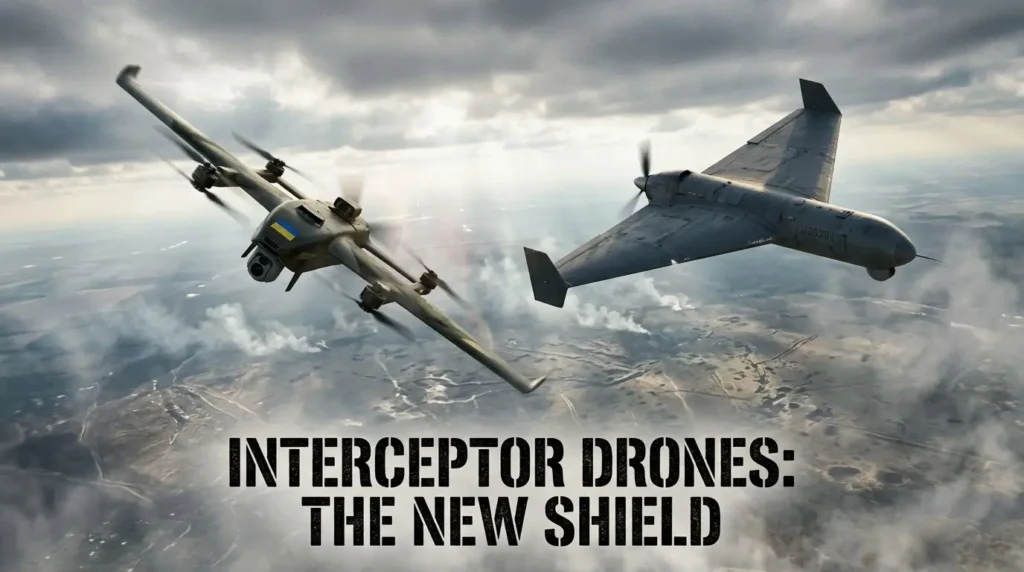
The second big shift is on defense. Instead of using expensive missiles against cheap Shahed-type attack drones, Ukraine has built interceptor drones that hunt them down. According to reporting on Ukrainian figures, the military received twice as many interceptors in the first four months of 2026 as in all of 2025, and Ukrainian interceptors destroyed a record 33,000 Russian UAVs in March 2026 alone. Germany has funded 15,000 units of the STRILA interceptor. More than 25 Ukrainian interceptor models have been authorized for military use.
The approach has a human bottleneck: fast interceptors need a much larger pool of well-trained pilots, which is why target drones now exist just to train the crews.
The kill zone and the rise of ground robots
Drones have turned the traditional front line into a deep “kill zone” where almost nothing survives for long if it moves in the open. Estimates of its width vary by source, from roughly 20 to 25 kilometers to about 35 kilometers, and it keeps growing as drone range increases. Russia has reportedly pushed fiber-optic drone range to 50 to 65 kilometers to strike logistics nodes.
That makes resupplying and evacuating troops extremely dangerous, and Ukraine’s answer is unmanned ground vehicles (UGVs):
- More than 280 Ukrainian companies are developing ground robots, and production reportedly rose 488% in 2025.
- Up to 80% of UGV missions are logistics: carrying food, water, ammunition and even FPV drones to positions. One Ukrainian commander says ground drones handle about 70% of his brigade’s frontline logistics.
- In April 2026, President Zelenskyy ordered the government to procure 50,000 UGVs by the end of the year.
- Robots are also going on offense. Ukrainian forces report clearing a Russian strongpoint near Kupiansk with ground robots, kamikaze UGVs and strike drones without Ukrainian soldiers entering the battlefield, and the Defense Ministry has announced “drone-assault units” that combine aerial drones, ground robots and infantry. In January, three Russian soldiers reportedly surrendered to a Ukrainian ground vehicle near Lyman.
- Survival is short. A typical battlefield UGV lasts only about seven missions, according to one manufacturer, though a record-holding model reportedly averages 57.
AI and autonomy: moving fast, with limits
Some ground robots now carry AI-assisted target detection, and engineers are working on wire-guided and highly autonomous systems that cannot be jammed. Analysts note that full autonomy is still far off. Ukrainian officers say many limits on autonomy are self-imposed because of ethics and international humanitarian law, and they warn that robots can misidentify targets, including civilians.
What the technology does not change
Experts repeatedly caution against overstating the robot revolution. Analysts at the Atlantic Council and the Lowy Institute stress that UGVs are not wonder weapons. Soldiers are still needed to clear trenches, hold ground and fight in urban buildings, and Ukraine’s manpower shortage remains a serious problem. Drones also did not end the war’s attritional character. They changed where and how the attrition happens.
Why it matters beyond Ukraine
Militaries and non-state actors around the world are studying this war. NATO made countering fiber-optic drones the central theme of its 2025 Innovation Challenge. The lessons are practical: cheap mass-produced systems can offset expensive platforms, electronic warfare alone is no longer enough, and the side that adapts its production and tactics fastest gains an edge, often only temporarily, before the other side responds.
Bottom line
The 2026 battlefield is defined by a race between drones and counter-drones, now extending from the air to the ground. The technology has made the front line deadlier and has pushed both armies to mass production, but it has not produced a decisive breakthrough. It has raised the cost of movement for everyone while leaving the basic need for soldiers in place.
Sources
- Euromaidan Press, “Ukraine approves more than two new drone systems a day this year” (July 2026)
- The Moscow Times, “A Revolution in Drone Warfare: As Russian Fiber-Optic Drones Flood the Battlefield” (August 2026)
- Atlantic Council UkraineAlert, “Fiber-optic drones have emerged as critical kit for both Russia and Ukraine” (February 2026)
- Atlantic Council UkraineAlert, “Ukraine’s robot army will be crucial in 2026 but drones can’t replace infantry” (January 2026)
- Ukraine’s Ministry of Defence, “Defense Forces’ arsenal reinforced with new interceptor drones”
- Ukraine’s Arms Monitor, “Drone warfare in Ukraine: key trends”
- CEPA, analysis on ground robots and the kill zone (May 2026)
- Lowy Institute, “In Ukraine, ground robots are increasingly going on the offensive”
- Washington Monthly, “Ukraine war ground drones UGVs” (August 2026)
- IEEE Spectrum, “Ground Robots Inherit the Kill Zone” (July 2026)
- NV, interview with DevDroid CEO Yurii Poritskyi on ground robots